A cracked lateral pipe under a North Central Phoenix front lawn can cost a homeowner several thousand dollars to excavate and repair. The water that runs through that pipe, technically, costs nothing at all.
That gap is the thing most buyers and sellers in this corridor get backward. They see "flood irrigation" on a listing sheet and assume it works like every other utility: you pay for what you use. In Salt River Project's service territory, the water itself belongs to the land, a right attached to the parcel rather than a commodity sold by the gallon. What homeowners actually pay for is everything downstream of that right: delivery, administration, and the private plumbing that carries water from the SRP gate to the lawn. That distinction sounds academic until a pipe fails, a neighbor stops answering the phone, or an escrow deadline collides with an irrigation schedule nobody read closely enough. In North Central Phoenix, where large irrigated lots are the defining feature of the market rather than an incidental amenity, understanding that distinction before a contract is signed is the difference between a smooth close and a surprise.
What You're Actually Paying For
SRP's own 2027 rate schedule, effective for bills due December 6, 2026, makes the split explicit. The annual water delivery fee, which covers administrative costs of servicing the account, rose to $97.34 per active account, up from $93.87 the year before. On top of that sits a basic charge for stored and developed water of $56.16 per acre for the first two acre-feet, plus $19.00 per additional acre-foot once a property exceeds its base allocation. None of that is a charge for the water. It is the cost of the system that moves the water, and increasingly the cost of a system that is showing its age.
| Fee | 2027 rate |
|---|---|
| Water delivery fee (per active account) | $97.34 |
| Basic charge, 1st and 2nd acre-foot (per acre) | $56.16 |
| Additional water, 3rd acre-foot and beyond | $19.00 per acre-foot |
| Account reactivation fee | $7.00 |
| New account fee | $25.90 |
Those numbers explain why a buyer touring a North Central estate on Solano Drive or near the Murphy Bridle Path should ask a different question than "how much is the water bill." The better question is who has been maintaining the private lateral between the street and the lawn, and how long it has been since anyone checked.
The System North Central Is Rebuilding Right Now
That maintenance question has a live, local answer. SRP recently launched its Community Irrigation Revitalization Initiative, a program aimed at aging flood irrigation infrastructure in neighborhoods where the canals and laterals predate most of the homes they now serve. A KJZZ report on the program in April 2026 pointed specifically to a stand of nearly 100-year-old eucalyptus trees near Northern Avenue in North Central Phoenix as an example of exactly what the initiative is built to protect: century-old canopy that exists because flood irrigation has been quietly watering these lots since before most of the surrounding homes were built.
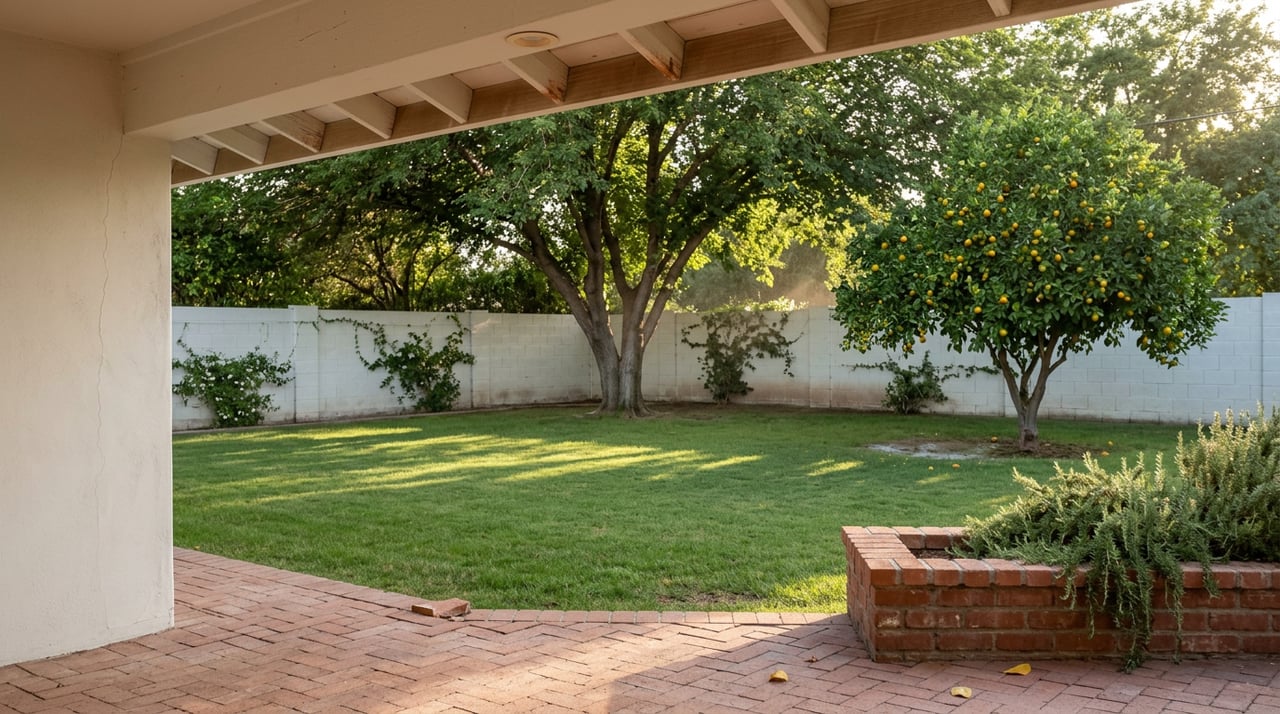
That history is not incidental to North Central's identity. W.J. Murphy platted the Orangewood tract along Central Avenue in 1895, planting citrus groves and extending irrigation to the land he was developing. The Murphy Bridle Path, which still runs along both sides of Central Avenue with its old-growth elm and olive trees, is a direct descendant of that original irrigation network. The North Central Phoenix Homeowners Association, which has represented roughly 2,500 parcels across the neighborhood's core between Missouri and Northern avenues for more than four decades, still describes large irrigated lots as one of the defining features it exists to protect. When SRP invests in repairing century-old delivery infrastructure here, it is not a generic utility upgrade. It is maintenance on the same irrigation legacy that gives these lots their canopy and, by extension, their value.
Why This Shows Up at the Worst Possible Time
None of this is abstract once a home goes under contract. Arizona's Seller's Property Disclosure Statement asks sellers to describe known material facts, and a property's irrigation schedule and associated costs fall squarely into that category. A seller who has been running the same recurring order for fifteen years without a second thought can still catch a buyer off guard if the disclosure describes the schedule but not the responsibility that comes with it: that the homeowner, not SRP, owns everything from the delivery gate to the lawn, and that late cancellation of a scheduled delivery can flood a yard within minutes.
SRP's delivery cadence itself is worth stating plainly, because it drives how a buyer should budget for the first year. Residential subdivision accounts receive water roughly every fourteen days during the summer months from April through September, and roughly every twenty-eight days in the cooler months from October through March, adding up to about eighteen irrigation runs a year. Missing an order deadline, or failing to inspect the neighborhood system before water arrives, is how flooding incidents happen. This is not a system a new owner can learn passively after closing.
Before writing an offer on a flood-irrigated lot in this corridor, a buyer should confirm a few specific things:
- Whether the SPDS discloses the current irrigation schedule and the account's annual cost, not just the fact that irrigation exists.
- Where the property's turnout or delivery gate sits, and whether it lies on the lot, in an easement, or in a shared right-of-way with neighbors.
- Whether the private lateral has been inspected recently by a contractor familiar with SRP systems, and what repairs, if any, are documented.
- Whether the neighborhood operates informally or through a formal Irrigation Water Delivery District, since SRP has no authority to intervene in disputes among neighbors over a private system.
- Whether the property carries a grandfathered irrigation right established before 1980, which under Arizona's Groundwater Management Act requires notifying the Arizona Department of Water Resources at the time of sale.
That last point catches more transactions than it should. Grandfathered rights do not simply disappear at closing, but they do not transfer silently either. A seller who forgets to notify ADWR, or a buyer who never asks whether the right exists, can end up sorting out paperwork weeks after the sale should have been final.
The Tax Angle Nobody Mentions
There is one upside to all of this that rarely comes up until a buyer's agent brings it up directly. Homes that qualify as contributing properties in North Central's historic districts, including Windsor Square, can apply for Arizona's historic property tax reclassification, which can reduce the property tax bill by as much as 45 percent for a qualifying home. It is a separate program from irrigation entirely, tied to historic designation rather than water rights, but the two often travel together in this corridor because the same century-old lots that carry irrigation rights are frequently the same lots old enough to qualify as historic. A buyer evaluating the total cost of owning an irrigated estate on Solano Drive or along the Bridle Path should ask about both the irrigation account and the historic designation status in the same conversation, because one can meaningfully offset the other.
Frequently Asked Questions
Does irrigation service transfer automatically to a new owner? Generally yes, since the right belongs to the land rather than the person, but grandfathered rights established before 1980 require the seller to notify the Arizona Department of Water Resources at the time of sale. Buyers should confirm this step happened rather than assume it did.
What if a previous owner already capped or removed the turnout? Ask for the permits or approval documentation. Converting a flood-irrigated area to drip irrigation or capping a turnout typically requires documentation that should be part of the property's records, and its absence is worth raising before closing rather than after.
Can a shared lateral become a legal problem between neighbors? It can, since SRP maintains the delivery gate but has no authority over private disputes downstream of it. Neighborhoods with ongoing maintenance friction sometimes form a formal Irrigation Water Delivery District to manage the system collectively, and asking whether one exists is a reasonable step in due diligence.
Flood irrigation is one of the reasons North Central Phoenix looks and feels the way it does, with canopy that took a century to grow and lots that a subdivision built today could never replicate. Understanding what that system actually costs, and who is responsible for what, is the difference between enjoying that feature and being surprised by it. If you are evaluating a flood-irrigated property in North Central Phoenix, whether as a buyer trying to price in the real obligations or a seller trying to disclose them correctly, Cambridge Properties can walk through the specifics with you before they become a closing-week problem. Request more info to start that conversation.