"North Central is the last remaining vestige of rural residential lifestyle that once existed in the Salt River Valley," said Mary Crozier, president of the North Central Phoenix Homeowners Association, in a 2025 interview with North Central News. "We believe it is an asset worth protecting."
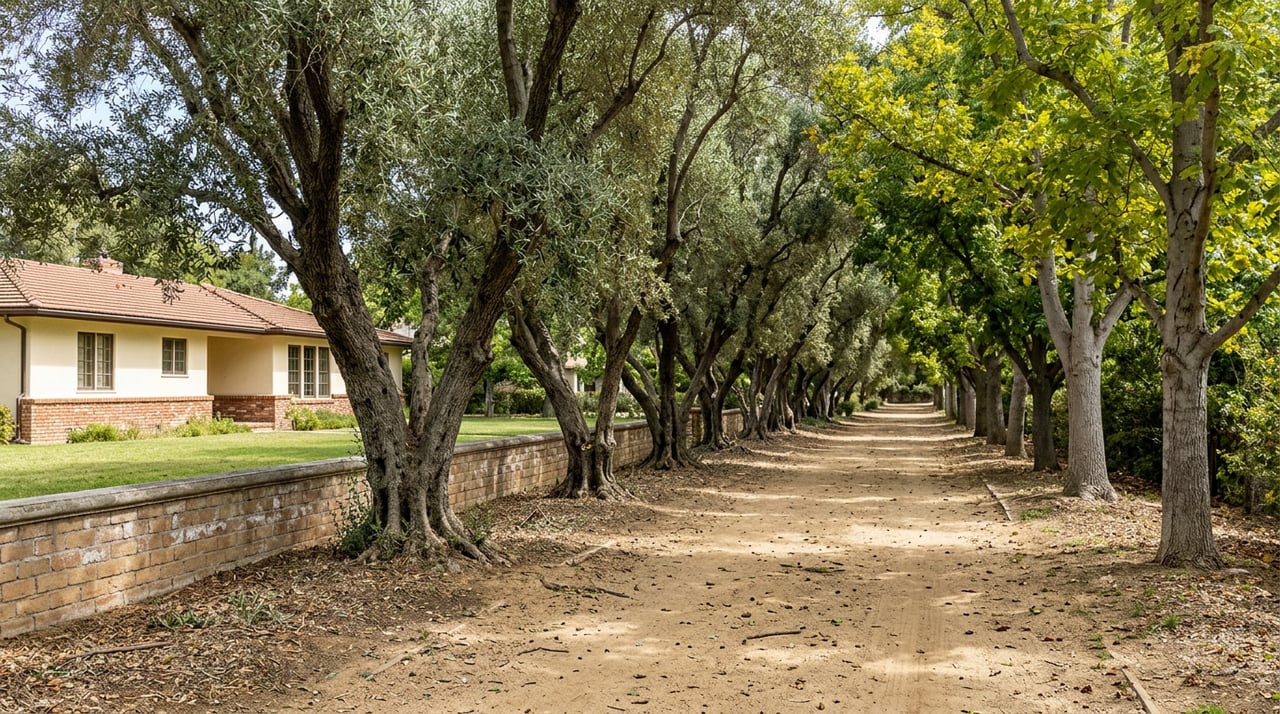
Most people who walk, run or ride along Murphy's Bridle Path never hear that quote. They just notice the dirt underfoot instead of asphalt, the shade from trees planted before the city had zoning codes, and the odd fact that every house fronting Central Avenue seems to stop its driveway a few feet short of the street. What looks like an accident of old-fashioned landscaping is actually a piece of protected infrastructure with a paper trail: a specific city resolution, a set of maintenance obligations, and a neighborhood association that has helped maintain the corridor for decades.
A Trail Older Than the Zoning Code That Would Otherwise Govern It
The path traces back to William John Murphy, who arrived in Phoenix from Illinois in 1883 and later built the Arizona Canal. In 1895 he platted the Orangewood subdivision along the northern stretch of Central Avenue and planted the citrus groves that gave the area its name. The road itself wasn't paved until 1920. It took almost three more decades before the strip alongside it became what residents now call the Bridle Path. According to the city's own historic preservation research, the earliest documented reference to the name dates to 1948, when the Arizona Horse Lover's Club formally dedicated the corridor for equestrian use.
That sequence matters because it means the trail predates almost every piece of modern land use regulation that touches it. The streetscape now holds a spot on Phoenix's Historic Property Register, and the city's preservation office has also put it forward for the National Register of Historic Places. The two-and-a-half mile stretch from Bethany Home Road north to the Arizona Canal isn't a park the city built for recreation. It's a working piece of infrastructure that residents have kept in continuous use, one horse, jog, and dog walk at a time.
The 1977 Rule Behind Every Short Driveway
Here's the detail that surprises even longtime residents: in 1977, the Phoenix City Council passed Resolution 14895, which specifically bars paving over the Bridle Path with concrete or asphalt to create driveway access to a private residence. If you've ever wondered why houses along Central Avenue seem to end their driveways at a strip of loose granite instead of running straight to the curb, that resolution is the reason. The city owns the land on both sides of Central Avenue up to the property line, and the surface has to stay permeable.
That's not just a neighborhood preference dressed up as policy. Phoenix's own construction standard for public multi-use trails calls for a surface of quarter-inch minus decomposed granite, compacted to a three-inch depth, the same specification the city applies to shared-use paths across the Valley. The Bridle Path isn't an exception to how Phoenix builds trails. It's one of the oldest examples of the standard the city still uses today, protected on this particular street by a resolution nearly fifty years old.
For anyone whose entrance apron has been paved over the years, either by a past owner or a contractor who didn't know better, the association's guidance is straightforward: check the property line, and if the path has been covered, replace it with the same quarter-inch minus granite the rest of the corridor uses.
Who Actually Keeps the Canopy Alive
The trees are where the story gets more interesting than a landscaping detail. The olive and ash trees lining Central Avenue are more than a century old, planted as part of Murphy's original development. Keeping that canopy alive has become a joint project between the city and the neighborhood association. When the City of Phoenix's parks budget tightened, tree replacement slowed to a handful of trees a year, funded largely through resident donations. The association's going rate to plant a replacement 24-inch box ash tree is $350, and it asks residents and neighboring businesses to sponsor them directly.
A separate maintenance detail concerns dog-waste bags. Years ago, an Eagle Scout installed doggie-bag dispensers along the trail to support the dog walkers who make up a large share of daily foot traffic. The city has since stopped restocking them. Under Phoenix Ordinance 27-12, anyone who fails to clean up after a pet on a public right-of-way can face a fine ranging from $100 to $2,500. In practice, keeping the bags stocked now falls to whichever neighbors or nearby businesses decide to pitch in.
None of this means the trail is neglected. It means the maintenance model looks less like a city park and more like a shared civic project, one where showing up with a bag of granite, a $350 check, or a box of dog-waste bags is treated as a normal part of living along the corridor.
If you live along or near the path, the practical takeaways are simple:
- A driveway apron across the Bridle Path has to stay quarter-inch minus decomposed granite, not concrete or asphalt, under a rule that has been on the books since 1977.
- Pet waste left on the trail can trigger a city fine of $100 to $2,500 under Ordinance 27-12. The city no longer restocks the bag dispensers.
- If a tree in front of your property dies or is damaged, the neighborhood association can help coordinate replacement plantings and accepts sponsorships for the roughly $350 cost of a new tree.
That's worth knowing whether you've lived along Central Avenue for thirty years or you're still learning which stretch of granite belongs to the historic overlay. The path isn't old by accident. It's old on purpose, and it takes ongoing effort to keep it that way.
Cambridge Properties pays attention to details like these because they shape how North Central actually functions day to day, not just how a listing photographs. If you have questions about what's protected along the corridor, what a specific property's obligations are regarding the path, or anything else about life in North Central Phoenix, reach out. We're happy to talk it through.
This article is general information, not legal, tax or financial advice. Consult a qualified professional about your situation.